Over the last year, Matrix powered more than 700 token engagement campaigns across multiple crypto ecosystems and chains.
These campaigns included paid-entry campaigns, ecosystem-sponsored challenges, cross-chain events, and broadcast competitions. They were designed to activate real participation inside token communities using native tokens rather than abstract points or passive tasks.
The original goal was execution.
Over time, something more valuable emerged: patterns.
1. Incentive Size Is Not the Primary Driver of Retention
Many teams assume that larger rewards automatically produce stronger engagement.
Across hundreds of campaigns, this was rarely true.
Oversized prize pools often created short spikes in activity followed by sharp drop-offs. In contrast, campaigns with calibrated entry requirements and balanced reward curves produced steadier participation and higher repeat engagement.
Structure consistently outperformed spectacle.
2. Timing Influences Participation Quality
Participation was not evenly distributed across time windows.
Campaigns aligned with natural community activity periods saw higher completion rates and stronger return behavior. Campaigns launched outside of those windows underperformed, even with comparable rewards.
Engagement is not only about what you offer, but when you offer it.
3. Native-Token Entry Changes Behavior
Requiring native-token participation materially altered outcomes.
Even small entry requirements filtered out low-quality activity and reduced bot behavior compared to free-entry formats. Participants who committed tokens were more likely to complete matches, follow campaign mechanics, and return for future events.
Incentive design shapes participant intent.
4. Participation Cohorts Behave Differently
Across campaigns, distinct participant types emerged:
- Competitive repeat players
- Casual participants
- Short-term opportunists
- Newly onboarded wallets
Uniform reward structures treated these groups the same way, often leading to inefficiencies. Campaigns that adapted structure and incentives to participation type achieved more durable engagement.
Segmentation consistently improved outcomes.
5. Rebuilding From Scratch Is Expensive
Many ecosystems redesign engagement campaigns from the ground up each time.
Without historical context, decisions around pricing, timing, and reward allocation rely heavily on assumptions. Across hundreds of campaigns, repeated trial and error proved costly in both token distribution and retention.
Context reduces waste.
From Execution to Intelligence
No single campaign revealed these patterns.
The insight came from accumulation.
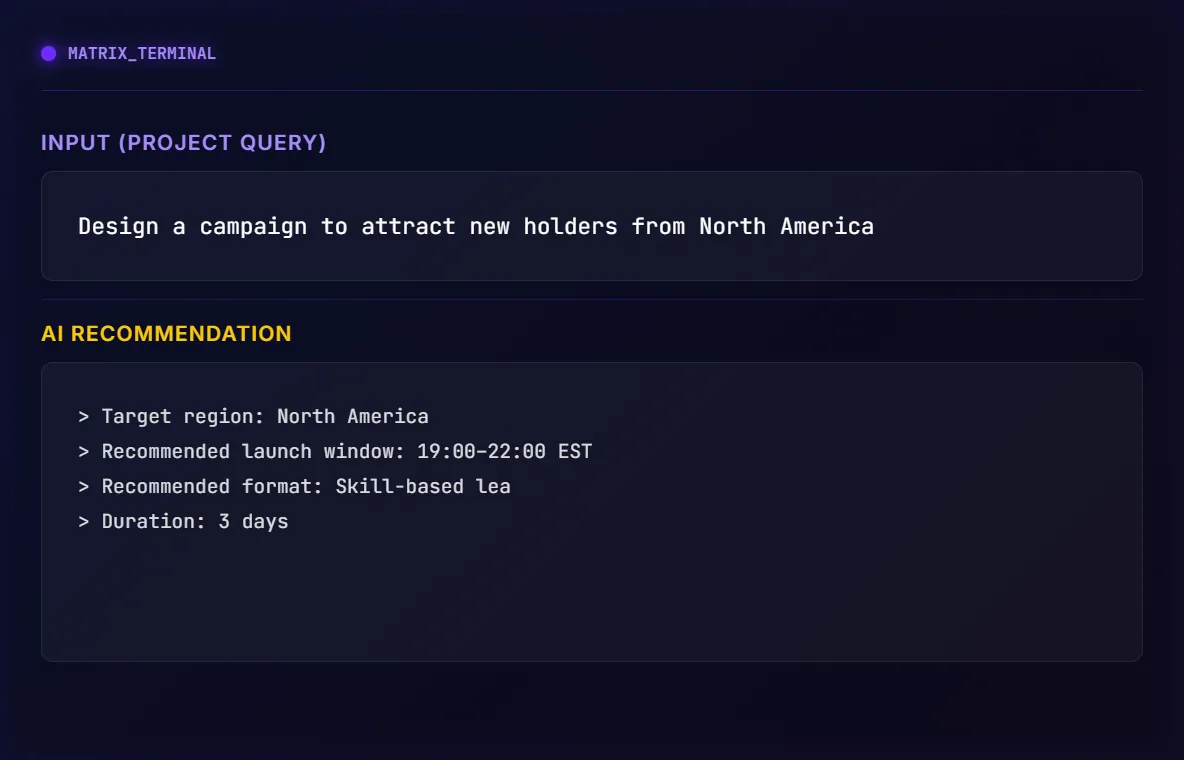
As campaigns ran across different ecosystems and formats, a structured dataset formed around participation behavior, timing sensitivity, reward calibration, and retention dynamics.
This dataset became the foundation for Matrix AI.
Matrix AI applies historical participation context to future campaign design. Instead of treating engagement as isolated events, teams can use accumulated behavioral data to plan more deliberately.
The goal is not to increase campaign volume.
The goal is to improve campaign quality over time.
Learn more about how Matrix AI works: matrix.fun/ai